Why the future of UX is invisible, wearable, and approval-first.
Imagine this: You wake up, glance at your watch, and it vibrates.
Your Sunday brunch at Olive Bistro is booked. Rooftop table for two at 11:30 AM. Swipe to confirm.
You swipe. A second vibration:
Cab booked for 10:55 AM, ₹175. Swipe to confirm.

No Zomato. No Uber. No Google Maps. No scrolling or tapping. Your AI agent handled it all.
This is the future of mobile computing — where apps fade into the background, and our daily interactions shift from endless taps to effortless approvals.
We are moving from search-driven feeds to notification-driven confirmations — a paradigm shift in how humans and technology interact.
1. The Death of the Feed Era
For over a decade, our digital lives have revolved around feeds and searches:
- Food → Open Zomato/Swiggy, scroll endless listings
- Travel → Open Airbnb/MakeMyTrip, browse 50 villas
- Entertainment → Open BookMyShow/District, pick seats manually
- Groceries, cabs, tickets, reservations → Repeat across 10+ apps
The 2010s UX was app-first, screen-first. Every company fought for your attention and time on-screen. But AI agents break this pattern.
The New Model:
- You express intent, not tap through flows
Book a Friday night dinner + jazz show for ₹2,500.
2. AI agents orchestrate everything behind the scenes
- Checks restaurants
- Finds events
- Calculates Uber timing & cost
3. You approve with one glance
Swipe → Done.
No browsing. No feeds. No app opening.
2. Rise of the AI-Agent Era
We are entering the age of AI agents — your digital concierge.
- You → give a prompt (voice or text)
- Agent → interacts with 10+ services via APIs, not UIs
- Result → 1 notification for approval
Your AI is now the real user of apps. You just supervise.
Example: “Plan my weekend in Goa”
- You say (on Watch/Ring):
Plan a weekend in Goa with sea-view stay, local dining, and one music event under ₹30,000.
2. AI agent does the magic:
- Fetches Airbnb stays
- Fetches local dining & events (Zomato/District, BookMyShow APIs)
- Calculates travel & budget
3. You receive 1 notification:
Swipe → Done.
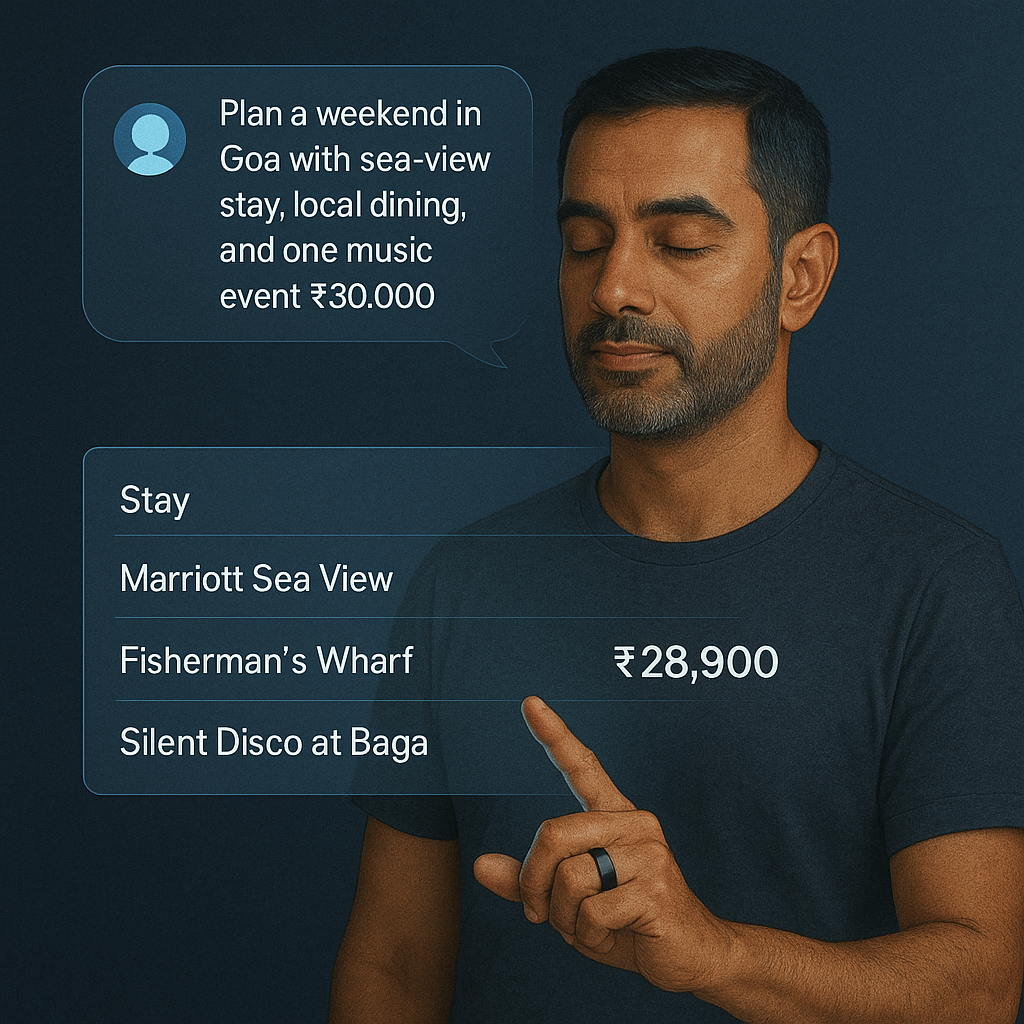
Result: 3-minute workflow → 30 seconds.
Interaction: 1 prompt + 1 swipe.
3. Why Interfaces Will Shrink
In an agent-first world, the role of human-facing UI changes dramatically.
- Old UX: 10 screens, 5 taps, 3 scrolls
- New UX: 1 prompt → 1 notification → 1 swipe
Screen time isn’t the metric anymore. Task completion and trust are.
Key UX Shifts
4. Devices in the Agent-First Future
As interfaces shrink to micro-moments, the device ecosystem shifts.
A. Wearables (Watchs, Rings, Glasses)
- Primary interface: Voice input + haptic output
- Use case: Approvals, reminders, quick prompts
- UX pattern: Prompt → Glance → Swipe
B. Phones (or Rabbit-like Pocket Agents)
- Secondary role: Fallback and media hub
- Use case: Media, social, camera, complex edits
- Future form: Could shrink to agent-first mini devices
C. Laptops / Desktops
- Deep work & creation hub
- Agent-assisted productivity: AI preps work, humans review
D. AR Glasses (Optional Future Layer)
- Ambient info overlay: Navigation, live updates, visual prompts
- No app grid — just contextual hints
5. Apps Become APIs
In this future, apps are no longer about feeds — they become services for AI agents.
- Zomato / District / Blinkit → Dining & Event Booking APIs
- Airbnb → Stay & Experience API
- Uber → Ride & Delivery API
- BookMyShow → Ticketing API
Only content-heavy apps survive as interfaces:
- Social: Instagram, YouTube
- Creation: Canva, Figma
- Trust / Fallback: Banking, Legal, Health
Most apps won’t fight for your eyes, they’ll fight to be in your agent’s network.
6. A Day in 2030
Morning (Wearable Dominates)
- Order coffee and breakfast delivery.
- Watch vibrates → Swipe → Approved
Workday (Laptop/Agent Blend)
- Agent prepares emails & slides
- You edit on laptop for 20 mins
Evening (Invisible Lifestyle)
- Book dinner + EDM event in Bangalore ₹3,000.
- Notification: Olive Rooftop + EDM at AntiSocial, total ₹2,800 → Swipe
Apps opened today: Zero.
7. The Big Implications
- Home screens will die → replaced by prompt launchers + notifications
- DAU and feed engagement collapse → Task completion is the new KPI
- UX design shifts → from pixel layouts to invisible trust flows
- Wearables replace phones for 70% of daily logistics
- Apps without content or trust fallback → become APIs
8. From Screens to Swipes: Designing the Invisible UX
The UX heroes of the agent era won’t design flashy feeds. They will design trust, prompts, and micro-approvals:
- Prompt UX → Teach humans how to express intent naturally
- Notification UX → Make 1-second glances feel confident
- Multi-modal UX → Voice, haptic, and cross-device orchestration
- Fallback UX → Easy human override for rare edge cases
The best apps of 2030 will be invisible. Success will be measured in tasks completed without opening the app.
Final Take
We are witnessing the biggest interface shift.
- Present: Scroll feeds, open apps, search manually
- Future: Speak intent, glance approval, live life
If apps become APIs and interfaces shrink to micro-approvals, your watch or AI ring may replace the phone for 80% of daily tasks.
I love talking about UI/UX. If you have any feedback or just want to have a casual conversation, reach out to me on LinkedIn
Here is the link to my Portfolio and Twitter

Designing for a world without apps: The future of invisible UX was originally published in UX Planet on Medium, where people are continuing the conversation by highlighting and responding to this story.