UK workforce compliance guide for product design teams
If you’re hiring product designers, UX/UI designers, UX researchers, content designers, design system designers, design managers, DesignOps specialists, prototypers, and freelance design partners in the UK, this 7-step guide is for you.
Disclosure: This guide is not legal advice, but it is grounded in current UK government, HMRC, ICO, ACAS, HSE and EHRC guidance.
The guide is brought you by Deel
1. The core UK rule: employment status is everything
In Great Britain, employment rights are built around three main statuses: employee, worker, and self-employed. UK tax status is assessed separately from employment-rights status, so someone can create risk in both HR and payroll even if the contract calls them a “freelancer.”
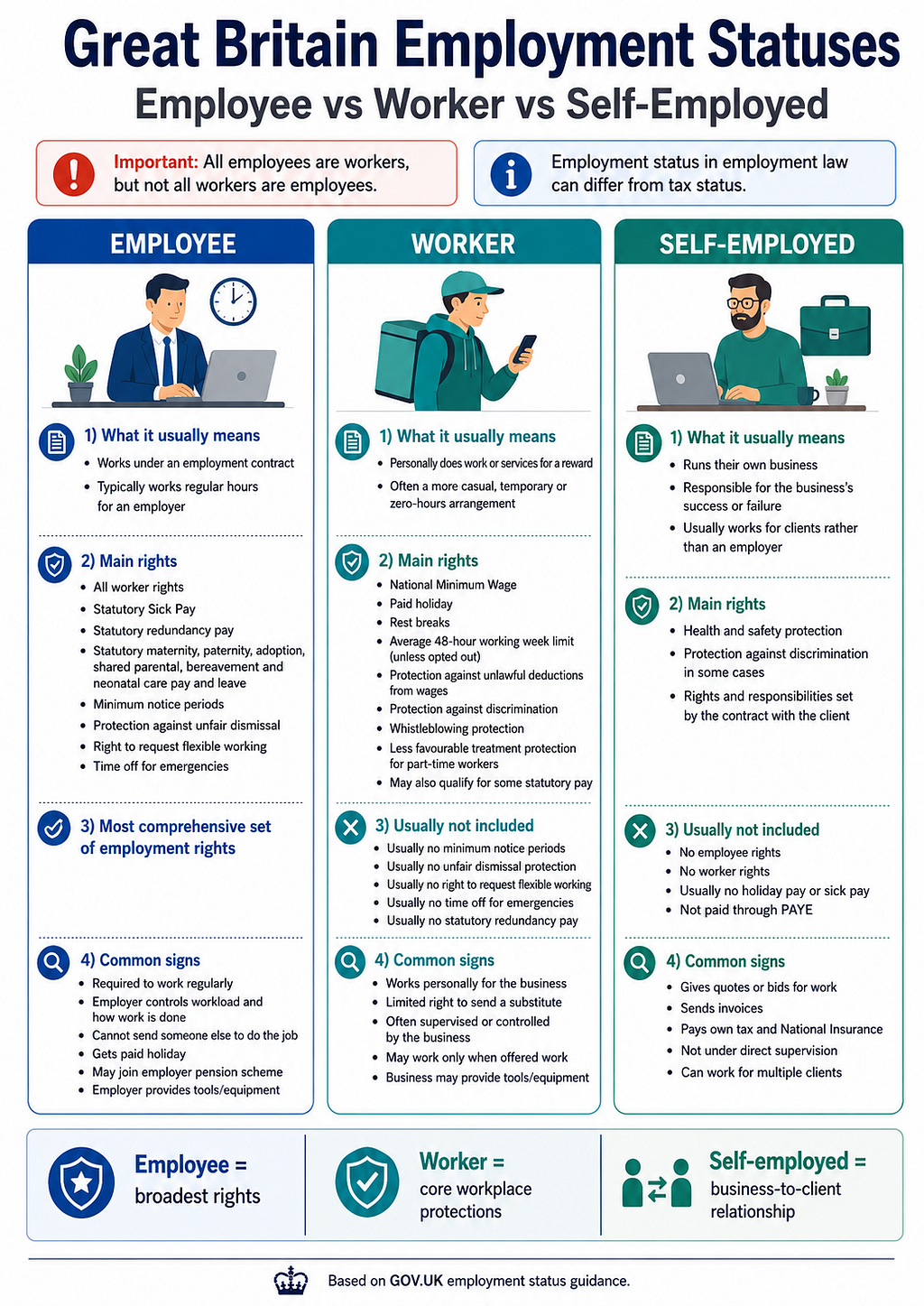
For product design teams, this matters because many teams use a mix of in-house designers, contract-based design leads, freelance UX researchers, agency staff, and contractor prototypers.
The label in the contract is not enough; the actual working relationship matters.
Before hiring anyone, decide what their role in your org will be: a full-time employee, a worker-style temporary role, a PSC contractor, agency labour, or an overseas hire.
Do this before writing the job ad, not after the offer!
Contractors, freelancers, IR35 and misclassification
If a designer works through a personal service company, the UK off-payroll working rules, commonly called IR35, may apply. These rules are intended to ensure that a contractor who would be an employee if engaged directly pays broadly similar Income Tax and National Insurance.
A “freelance” designer is more likely to create IR35 risk if they work full-time for one company, use company equipment, attend all rituals, report to a design manager, need approval for holidays, and are presented internally as part of the permanent team.
2. Recommended hiring model for UK product design team members
To streamline hiring process for design team members, you can use the following framework:
- Core product designer embedded in squads → Employee
- Design manager or design system lead with ongoing ownership → Employee
- UX researcher for a 6-month discovery project → Fixed-term employee or carefully scoped contractor
- Visual designer for a one-off campaign → Self-employed contractor
- Senior designer from outside the UK → Sponsored Skilled Worker or other visa route (like Global Talent Visa).
3. Hiring and recruitment compliance
Hiring compliance is a huge topic, so in order to make the guide more focussed, we will focus on 4 main areas:
Job adverts & selection
Job advertising in UK should be written according to the UK laws.
UK employers must avoid discrimination in job adverts, shortlisting, interviews, and selection.
Protected characteristics include:
- age
- disability
- gender reassignment
- marriage and civil partnership
- pregnancy and maternity
- race
- religion or belief
- sex
- sexual orientation.
Never ask candidates about protected characteristics, marital status, children, or plans to have children.
Equality-monitoring information that many org collect should be collected separately and never shown to people making the hiring decision.
When hiring product design team member, the safe approach is to use a structured rubric:
- portfolio quality
- problem framing
- research depth
- interaction design
- systems thinking
- accessibility awareness
- soft skills (like collaboration and communication)
This reduces bias and help the org hire right person for the job.
Right to work and immigration
All UK employers must carry out a right-to-work check before employment begins.
Check methods include manual document review, digital identity document validation for eligible British and Irish citizens, and the Home Office online service for many non-British and non-Irish citizens (like UKVI immigration code check).
UKVI code validation is the fastest and safest way of validating information. For Home Office online checks, the candidate provides a share code, and the employer verifies the person’s right to work before the start date.
When it comes to immigration status for overseas product people, UK Skilled Worker sponsorship may be relevant.
The usual Skilled Worker salary threshold is at least £41,700 per year.
The UK Global Talent route may also be relevant for senior digital product specialists because it does not require a job offer and can cover technical or business expertise in digital technology.
Portfolio tasks & practical design exercises
This is one of the biggest product-design-specific UK risks.
Unpaid design tasks can become a National Minimum Wage problem if the task is effectively real work.
Advisory, Conciliation and Arbitration Service (Acas) says unpaid work trials should be reasonable and generally no longer than one day; if the person is doing real work rather than being assessed, minimum wage may be required.
If you want to give your candidates home task assignment, keep tasks short and unrelated to live commercial work.
Give candidates a clear time box, assessment criteria, and reasonable adjustments. Its a right thing to do (both from compliance and ethical point of view) to pay candidates for longer tasks, take-home strategy work, workshops, or anything that could create usable product output.
AI screening and candidate data
Pretty much every org uses AI screening tools to process incoming replies to open design roles. But not every org manages private data carefully.
Recruitment data is covered by UK data protection law. It means that ICO’s recruitment guidance covers the full recruitment lifecycle, from advertising roles to deleting candidate information, and includes sensitive data such as health, diversity, and criminal-conviction information.
When you use AI tools for screening, you must be especially careful with tools that rank CVs, screen portfolios, score video interviews, or automatically reject candidates.
UK GDPR restricts solely automated decisions that have legal effects, unless a valid condition applies and safeguards are in place (like human intervention, explanation, challenge rights, and bias controls)
When you use AI tools for screening and data processing never let AI make final hiring decisions for designers!
Use AI only as an assistant, keep human review, document the logic, test for bias, and always tell candidates how their data is used.
4. Payroll basics for UK design employees
For UK employees, the employer normally needs to run payroll through PAYE, report pay and deductions to HMRC, pay HMRC tax and National Insurance, keep payroll records, and handle annual reporting tasks.
Every UK employer also has workplace pension duties if they employ at least one person (including assessing staff and contributing for eligible workers).
Almost all workers are legally entitled to 5.6 weeks of paid holiday per year. For a five-day-week employee, that is 28 days.
When it comes to product designer hiring, when budgeting for a UK product designer, a rule of thumb is not compare only gross salary to contractor day rate.
Add employer NICs, pension contributions, holiday, sick pay, tools, equipment, training, and management overhead.
Gender pay gap and pay transparency
UK employers with 250 or more employees must publish gender pay gap data annually. The usual snapshot date is 5 April for private and voluntary-sector employers and 31 March for most public-sector bodies, with reporting due within one year.
Current UK government guidance says gender pay gap action plans are voluntary now, with mandatory requirements expected from spring 2027.
Its recommended to create pay bands for product designer, senior product designer, lead product designer, principal designer, design manager, head of design, UX researcher, and content designer. Even when not legally required, clear bands reduce inconsistent offers and help defend decisions.
5. Employment contracts and day-one documents
Employees and workers must receive a written statement of employment particulars at the start of employment. The principal statement is due on day one, with additional information due within two months.
Required information includes:
- pay
- hours
- holiday
- place of work
- probation
- benefits
- sick pay
- paid leave
- notice
- pension
- training
- disciplinary/grievance details
For product design teams, the contract should cover:
- ownership of design files in Figma, prototypes, design systems, components, research reports, design tokens, copy, icons, code snippets, and documentation;
- confidentiality and client data;
- use of AI tools (approved and not approved tools) and whether client/user data can be entered into them;
- third-party assets, stock imagery, fonts, templates, and open-source code;
- equipment and software licences;
Important: clearly describe design assets ownership in a contract. Without a clear ownership, a freelance designer can deliver a full design system and still own the copyright unless the agreement properly transfers it.
Do not rely on “we paid for it, so we own it.”
6. Working time
UK workers generally should not work more than an average of 48 hours per week, unless they opt out or reduce hours across jobs.
Employees have the right to request flexible working from the first day of employment. Its possible to make two statutory requests in a 12-month period, and employers must handle requests reasonably and may refuse only for genuine business reasons.
Product designers typically work in hybrid model: a couple of days in office, and the rest of the work week from home. To minimize the chance for misunderstanding after hiring a new team member, its a good idea to write down your collaboration model and share it up front with a potential team player upfront. For example: “remote-first with two office days for design critique and product planning,” or “hybrid squad rituals from 10:00–15:00 London time.” This makes flexible-working decisions easier to justify and reduces inconsistent treatment.
7. Sick pay, parental pay and redundancy
From 6 April 2026, Statutory Sick Pay is payable from the first full day of sickness absence and is available to eligible employees regardless of earnings. The rate is the lower of the statutory flat rate or 80% of average weekly earnings. This applies across the UK.
In 2026 many org trim down product teams to maximize operation efficiency. If a product area is being closed, do not simply “cancel” designers’ roles. Treat it as a proper redundancy or restructuring process.
For redundancies on or after 6 April 2026, a week’s pay is capped at £751, and the maximum statutory redundancy payment is £22,530.
This guide was prepared by Nick Babich

Hiring a product team in the UK? Here is what you need to know was originally published in UX Planet on Medium, where people are continuing the conversation by highlighting and responding to this story.