The Fusion of AI & XR — Part 3! Read Part 1 and Part 2
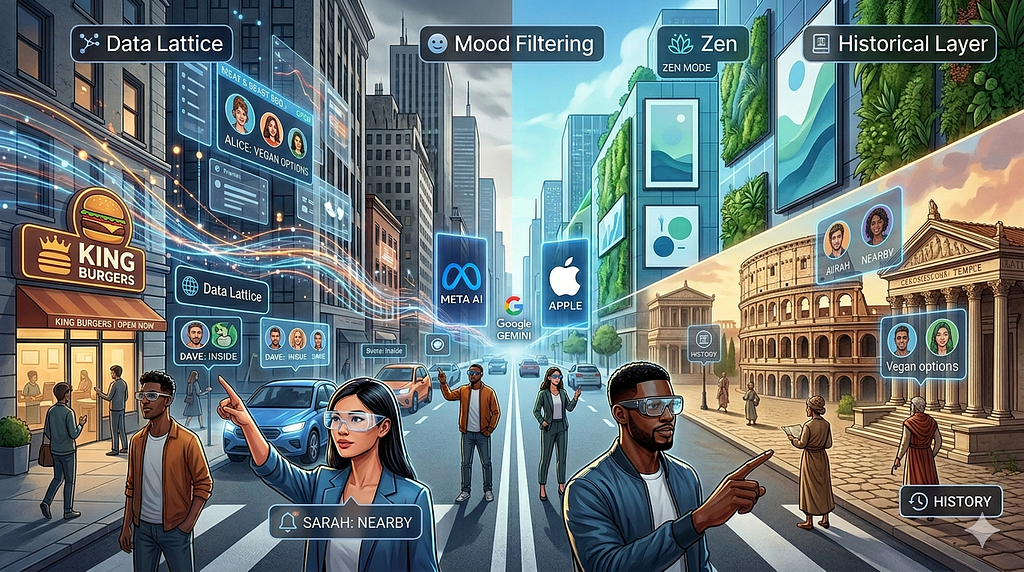
The era of “static” Augmented Reality is over. We are moving from simple digital overlays to a world where AI acts as a “Reality Engine” – filtering, altering, and skinning our world based on our needs, moods, and personalized data layers.
In my previous articles (from 2020–2021), I predicted and talked about the “Super-Powers” AI-driven XR (AR/VR) devices can give us, which Google and Meta are already allowing us to do with their AR glasses and XR Headsets. But as we look toward the next decade, the fusion of AI and XR is evolving into something much more profound: The Layered Reality.
1. AI Data as the New “Lattice” of Reality
Imagine walking down a street. Your eyes see the physical architecture, but your AI-powered glasses see a lattice of data. Think Meta’s current Ray-Ban Display glasses (I love their Gent 2 glasses), the upcoming Google’s AndroidXR glasses, and Apple’s AI/AR Smart Glasses (which they are secretly developing according to Mark Gurman).
We aren’t just talking about floating Wikipedia bubbles anymore. We are talking about Contextual Intelligence. Using multimodal LLMs like Google’s Gemini or Meta AI, your glasses don’t just “see” a restaurant; they understand your dietary preferences, your current hunger level, and whether your friends are currently inside.
The data isn’t on the screen; it’s in the world. This is the shift from “Heads-Up Displays” to “Spatial Intelligence,” where AI understands the 3D geometry of your physical space and the semantic meaning of the objects within it.
2. On-Demand Mood-Based Reality Filtering (The “World-Skinning” Era)
One of the most exciting (and perhaps controversial) shifts will be the use of AI Filters to alter reality. Just like people today use filters on Instagram to enhance selfies, we will soon use AI to “skin” our entire environment.
- The “Zen” Layer: Feeling stressed? Your AI can silence the visual “noise” of city billboards and ads, replacing them with digital greenery or calming minimalist art.
- The “Productivity” Layer: In the office, your environment shifts to a high-focus mode — dimming distractions and highlighting only the tools and data relevant to your current task.
- The “Historical” Layer: Walking through Rome or Jerusalem? The AI reconstructs ruins into full-scale 3D models in real-time AR layers (on site) or in VR (at home), letting you walk through history as it was.
We are entering an era where perception is a choice. If AI can alter our reality based on our moods, what does that do to our shared human experience? For us — Designers, Developers, and Creators — it’s a UX challenge unlike any we’ve faced before.
3. The Business Opportunity: A New Gold Rush
For the creators, startups, and enterprises — The “Spatial Web” is the new frontier. This isn’t just about making apps; it’s about Spatial Data Layers.
- For Creators (Designers & Developers): There is an opportunity in “Reality Skinning.” Designers will move from 2D UX/UI design to 3D “Environmental UX.” Developers will be the architects of these new digital layers. Take a look at Snapchat Filters and their Snap Spectacles 5 AR glasses. If people want filters, someone has to design that.
- For Startups: You don’t build the glasses; build the Vertical Layers. A startup could own the “Real Estate Layer,” providing instant, AI-driven valuation and structural data to anyone wearing XR glasses. Another could own the “Retail Layer,” turning every physical store into a personalized, interactive showroom or a digital try-on mirror.
- For Enterprises: Organizations can leverage AI to bridge the gap between digital data and physical labor. Imagine a technician with Ray-Ban Meta glasses receiving real-time, AI-guided repair instructions overlaid directly onto a machine — no manuals needed (which even you and I could do if we have the time).
4. The Big Tech Play: Meta vs. Google vs. Apple
We are seeing the opening shots of the “Glasses War.”
- Meta is winning on the “Social & Casual” front. Their Ray-Ban glasses are stylish and normalized, using Meta AI to identify objects, translate text on the fly (and even captions with Meta-Rayban Display glasses), and provide real-world navigation. They are making AI wearable!
- Google is playing the “Ecosystem” game. With Android XR and Gemini, they are looking to do for glasses what they did for smartphones — creating a massive, open-ish platform that plugs into the world’s most powerful information index (I was amazed using Gemini on Galaxy XR).
- Apple is raising the bar with The Best User Experience (which is what me and anyone who tried Apple Vision Pro really liked about it) and their Privacy and On-Device AI approach. Let’s see what they’ll do with AI Smart Glasses and AR Glasses (currently, they are losing the AI race).
Where do we draw the line?
As I’ve said before, technology is a double-edged sword. When we start “filtering” our reality, we risk living in digital bubbles where we only see what we want to see. But the potential for empathy, productivity, and pure human wonder is too high to ignore.
Moreover — In the era of Fake News and the absence of TRUTH, the Personal AI Assistant on our Glasses will be able to help us with Critical Thinking, Real-Time Fact-Checking, and dealing with Misinformation and manipulation by bad actors worldwide (foreign propaganda etc.).
Think about “AR Labels” on criminals, perverts, racists, antisemites, and even potential terrorists (based on their past or online activities) in public places so kids, women, and minorities will be able to avoid dangerous encounters and call the authorities if needed.
Better future with XR?
With smartphones, humans gained access to all of humanity’s knowledge at their fingertips, but instead of becoming smarter, we got lost in social media bubbles and hate-filled echo chambers, while being bombarded with endless content from bad actors manipulating social media algorithms with bot farms and AI DeepFakes.
With AI and XR, humans will have a better chance of becoming smarter, developing critical thinking, and fact-checking anyone in real time, whether while speaking with someone in person, talking with them online, or even consuming content through their XR glasses. This is the fusion of AI and XR for more advanced Spatial Computing and Spatial Intelligence.
What will you build in the era of AI & XR?
#AI #XR #AR #SpatialComputing #MetaAI #GeminiAI #AppleVisionPro #UXDesign #FutureTech #Startups #ProductDesign #WebXR #DigitalTwin #TechEthics

AI & XR are made for each other 3: Reality as a Multi-Layered Canvas. was originally published in UX Planet on Medium, where people are continuing the conversation by highlighting and responding to this story.