If you’re building a globally distributed product design team and looking for a platform that will help you with HR and payroll activities, you’ll likely choose between Deel and Remote. Both platforms solve the same fundamental problem (hiring and managing talent internationally without opening local legal entities); however, there are a few key differences you need to be aware of to make an informed decision, and we will discuss the differences in this article.
The Real Team Scenario
To make our comparison less abstract and more specific, let’s add a real context for the company. Imagine you’re running a Series B AI company.
Your design team has:
- Head of Design (UK)
- Senior Product Designer (Germany)
- Design System Lead (Poland)
- UX Researcher (Spain)
- Motion Designer (Brazil)
You need to add:
- Product Designer in Argentina
- UX Writer in Portugal
- Contract illustrator in Poland
What makes this scenario particularly relevant for product organizations is that design teams rarely scale in a linear way.
Unlike engineering teams that often hire primarily full-time employees, design organizations frequently combine full-time designers, specialized contractors, agencies, and freelance contributors. This creates unique operational challenges around onboarding, payments, access management, equipment provisioning, and compliance that global employment platforms must solve effectively.
You want to make sure that new team members won’t face any bureaucratic problems during onboarding.
Round 1: Contractor Management
Product teams use contractors more than the majority of other teams. Because product design is a multi-step process, the product team might need help with a particular task at some step. And then the team hires contractors to do the job.
Common examples:
- Brand designers
- Illustrators
- Motion designers
- UX writers
- Research specialists
For design teams, contractor experience matters more than many leaders realize. Top design talent often works with multiple clients simultaneously and compares onboarding experiences across companies. A slow contract approval process, a confusing invoicing workflow, or delayed payment can directly impact a company’s ability to attract and retain specialized talent.
Plus, contractors often become future employees. That’s another reason why contractor workflows are extremely important.
Deel
Deel started as a contractor-focused platform, and to this day, it remains very strong in this area. Some key advantages of this platform include:
- Mature contractor workflows where you can set multiple attributes of the future contract.
- Automated invoicing and one-click international payments. Deel also supports a wide range of contractor payment methods, including local bank transfers, PayPal, Payoneer, Wise, and crypto options in some regions. This flexibility can be particularly valuable when hiring creatives and freelancers across different markets.

Deel currently charges approximately $49/month per contractor.
Remote
Remote also supports contractors globally, but its contractor workflows are much less sophisticated than Deel’s. Remote places place significant emphasis on contractor classification guidance.

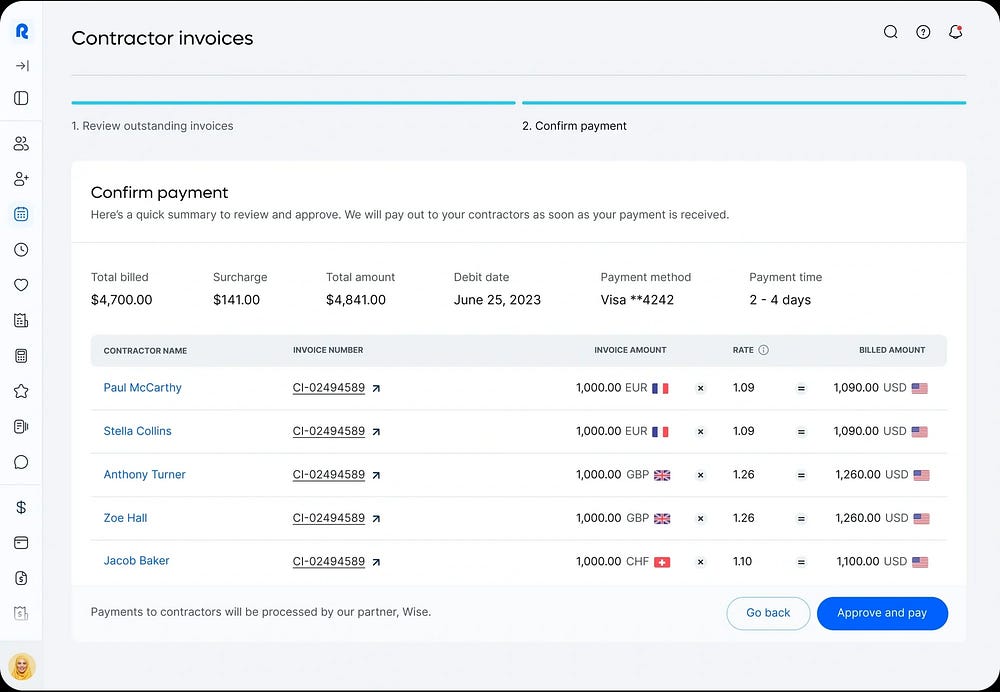
And the platform is also priced lower than Deel for contractors (current rate is £23/per contractor for Contractor Management).
Winner: Deel
For design organizations that regularly hire freelancers, Deel’s contractor robust workflows still give it an edge.
Round 2: Converting Contractors into Employees
For design organizations, contractor-to-employee conversion is often a strategic hiring channel rather than an exception. As was mentioned previously, many design leaders intentionally begin relationships through contract engagements to evaluate collaboration style, communication skills, and design quality before making a long-term commitment.
A design team often hires:
- Contractor
- Extended contract once or twice
- And then offers the contractor a full-time position in the org
If this transition is difficult, scaling becomes painful. This is one of the most common, yet, overlooked, workflows.
Deel
Deel has invested heavily in creating a unified workflow between contractors, EOR employees, regular employees, and the payroll. What’s great about the Deel is the experience it creates: the experience feels like moving people through one workforce system rather than multiple disconnected tools.

Remote
Remote supports the same transition but places more emphasis on employment compliance and local legal requirements.
Winner: both Deel and Remote
Both platforms offer a seamless experience for converting contractors into employees.
Round 3: Compliance Risk
Compliance risk can define the trajectory for your origanization.
Compliance becomes particularly important when design organizations begin hiring researchers, accessibility specialists, healthcare designers, or employees working on regulated products. Misclassification penalties, payroll mistakes, and local employment violations can create substantial financial and operational risk.
The platform that can handle this effectively can save a company a lot of $$$.
Deel
Deel has significantly strengthened its compliance position over the past few years through acquisitions, expansion of owned entities, and investments in local payroll infrastructure. The compliance gap between Deel and Remote is considerably smaller today than it was several years ago.
However, market perception still tends to associate Deel with speed and scale, while Remote is associated with compliance rigor.
Remote
Remote built much of its reputation around owned legal entities, local employment expertise and employment compliance. It has exceptional worker classification protection which makes this platform amazing at compliance. Remote’s ownership model remains one of its strongest differentiators.
Winner: Remote
Remote repeatedly positions compliance as its primary differentiator. And this can be especially important for highly regulated organizations.
Final round: Design Operations
After 3 rounds, we don’t have a clear winner, so it’s important to run another, extra round and focus on what’s really important for product teams: design workflows.
A design leader cares about onboarding, documentation, reporting, performance management, compensation reviews and global headcount visibility. So let’s see how both platforms handle this.
Deel
Over the past few years Deel expanded well beyond payroll.
The platform now includes HRIS, performance management, workforce planning, compensation tools, immigration support, and equipment management, making it a universal solution for the business.
Remote
Remote offers HRIS capabilities but remains more focused on employment infrastructure, payroll and compliance. Its platform scope is intentionally narrower.
Winner: Deel
Especially for companies building Design Ops functions.
Final Verdict
Choose Deel if:
- You frequently hire contractors and freelancers and expect contractors to convert into employees
- You want HRIS, performance management, compensation, and workforce planning in one platform
- You are building a mature Design Operations function
Choose Remote if:
- You operate in highly regulated industries and compliance is your primary concern
- You already have established HR systems
- You want a focused platform centered on employment infrastructure
Written by Nick Babich

Deel vs Remote for Product Design Organizations was originally published in UX Planet on Medium, where people are continuing the conversation by highlighting and responding to this story.