A global payroll platform cannot function without personal data.
To pay an employee correctly, a company needs an employee’s personal details such as their legal name, home address, tax identification number, bank details, employment contract, salary information, benefits selections, government-issued identification, and country-specific compliance documents.
For globally-distributed teams, the question is therefore not simply:
“How do we ask users for consent?”
But rather
“How do we clearly distinguish information that must be processed to employ and pay someone from information that the worker can genuinely choose to share?”
This is one of the most consequential compliance pain points that globally-distributed product teams face when using HR & payroll products. It affects pretty much every flow in a platform, from initial onboarding, to actual payroll administration.
Deel provides a very elegant solution to this problem. But before I show you a solution, it’s important to dive into the nuances of the problem itself.
Why the traditional consent pattern breaks down
Many digital products treat privacy compliance as a UI component. Add a checkbox, link to a privacy policy, record the timestamp, and move on.
That approach is especially dangerous in employer-employee relations.
Employees may accept consent requests and provide personal information without fully understanding what they are agreeing to. This creates “blind consent”: agreement that appears valid in the interface but may be neither properly informed nor freely given.
And blind consent leads to 4 scenarios in compliance workflows:
- Some data is processed because it is necessary to fulfill an employment contract, run payroll, satisfy a legal obligation, or comply with local tax and employment rules.
- Other data access or sharing may be genuinely optional and should be controlled by the worker.
- Some actions require acknowledgment rather than consent.
- Some optional activities require explicit and reversible permission.
Combining all four situations into one “I agree” checkbox leads to a bad experience. It suggests that the worker can refuse processing that may actually be necessary, while simultaneously making genuinely optional sharing feel mandatory.
Deel’s approach: separate required processing from permissions
Deel has a few excellent mechanics that make the process more flexible and predictable for both parties (both employee and employer).
One particularly relevant part of Deel’s documented employee-account flow is its contextual onboarding. Employees can clearly understand why their employer may need specific documents because org provides additional information in the context of requesting for info.
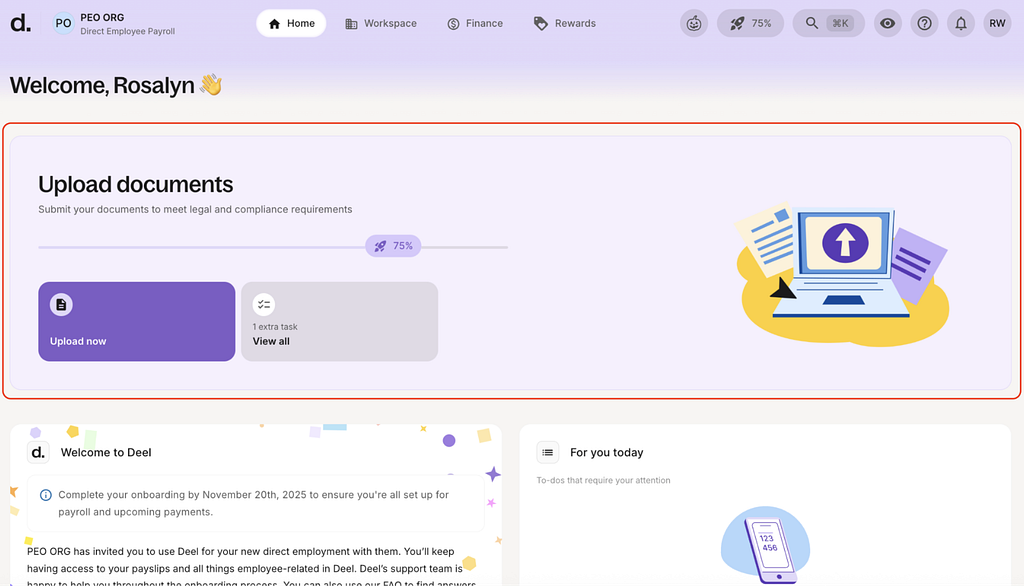
The user can understand what information is affected, who will see it, and what decision they are making.
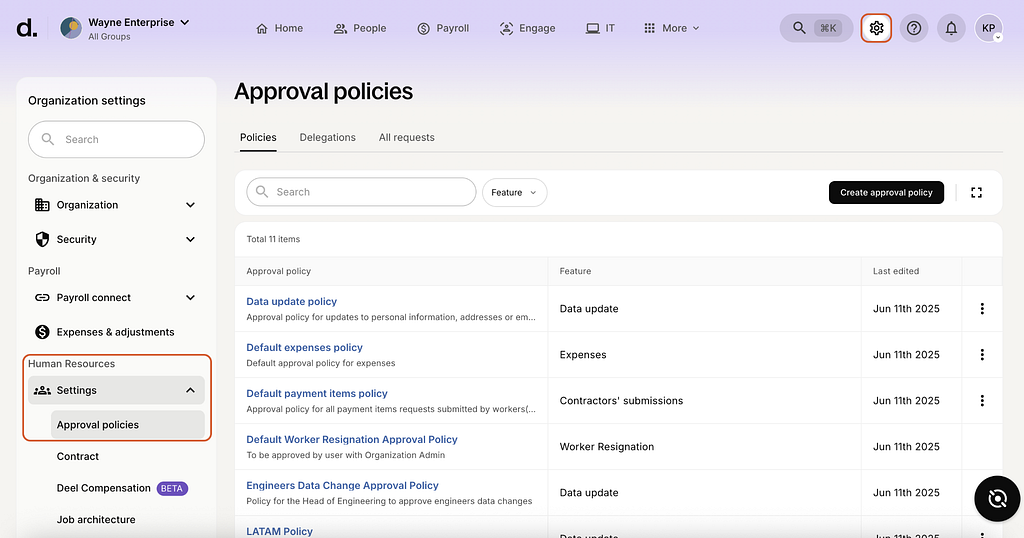
Deel’s document-management model adds another layer: Approval policies.
Workers can view required compliance documents and identify whether documents are mandatory or optional. Deel also make it possible to combinine the information into individual policies that are shared with the employees.
These two mechanisms point toward a stronger privacy UX model:
Treat access as a relationship between a particular person and organization they work at.
And that is much more precise than treating privacy as acceptance of one platform-wide policy.
Compliance rules can change without affecting the UX
Country-specific requirements change constantly. A document that is optional in one country may be mandatory in another.
A required tax field may change format.
A new statutory contribution may affect payroll.
An employee’s relocation may change which rules apply.
Because Deel’s compliance approach is embedded within payroll and workforce workflows, it allows the platform to monitor changes, flag relevant risks, and centralise compliance signals, while final decisions remain with the client.
The platform practices informed participation rooted in 3 things
- What must happen (i.e., “This tax information is required to calculate and report your payroll.”)
- What the user can choose (i.e., “You can choose whether your employer can directly view this document.”)
- What the platform will do
Deel does not ask users to blindly trust the platform is handling their information correctly. It continuously shows them what is required, what is optional, who has access, and why each action is happening.
Written by Nick Babich

The Hidden Compliance Challenge in Global Payroll UX was originally published in UX Planet on Medium, where people are continuing the conversation by highlighting and responding to this story.