
For decades, we interacted with computers through graphical interfaces: buttons, menus, forms, and screens. This paradigm of interaction worked perfectly fine since the early 90s till the modern day.

AI is rapidly changing that.
Instead of navigating interfaces, people are more and more relying on voice to describe what they want in natural language. As a result, the interaction model is shifting from clicking to talking.

Voice is becoming so important because it removes much of the friction associated with traditional interfaces.
As a user, you no longer need to learn navigation patterns, memorize commands, or search through menus.
You can express intent directly.
This shift is becoming more visible as voice technology improves. A few years ago, talking to computers often felt unnatural and frustrating.
Today, platforms like ElevenLabs are making voice interactions sound remarkably human, helping you feel more comfortable communicating with AI through conversation rather than commands.
The nature of voice interaction
When we discuss voice interaction with a computer, we want to focus on three things:
1. Lowering learning curve
Voice democratizes interaction with digital systems. When using traditional software, you typically translate your goals into a sequence of actions:
Open this menu.
Click this button.
Fill out this form.
With voice, you can simply say:
“Create a presentation about AI adoption in healthcare.”
or
“Summarize the key findings from this report.”
or
“Design a dashboard for customer retention metrics.”
And the system figures out the steps.
Focusing on intention rather than interaction
Once the user articulates their goal, the AI system will determine the actual steps it needs to take to achieve it. And this demonstrates another important shift:
The interaction becomes less about operating software and more about communicating intent.
Voice interactions are more human
If you haven’t watched the movie Her (2013) with Joaquin Phoenix, I highly recommend it, as it clearly demonstrates how voice interaction with AI makes people think & feel about digital systems.
Voice can make people fall in love with AI

As AI agents become more capable, voice may evolve from a convenience feature into a primary interface layer.
The Future of the voice interface
Will traditional graphic UI disappear?
No.
Visual interfaces remain essential for reviewing information, comparing options, editing content, and making decisions.
But the role of the interface may change. Instead of being the primary way we control software, it may become the place where we inspect, refine, and approve what AI creates based on the voice input.
Voice and personality
Voice interaction is not just about speech processing and synthesis. It’s an identity layer.
What makes voice so strong is that we typically associate it with a real human being. Even when we know that it’s AI, we still think of it as a person.
The impression we form when using a voice assistant of a particular organization impacts the org’s business bottom line as we immediately form an impression of the org’s professionalism and trustworthiness.
Here are a few scenarios businesses can follow to maximize the personality effect in voice interactions:
- Voice clone of CEO. This is an excellent approach for small businesses where customers know the CEO and expect to hear their voice.
- Mascot voice. If an organization uses a mascot, it can be a good idea to replicate its voice for voice interactions.
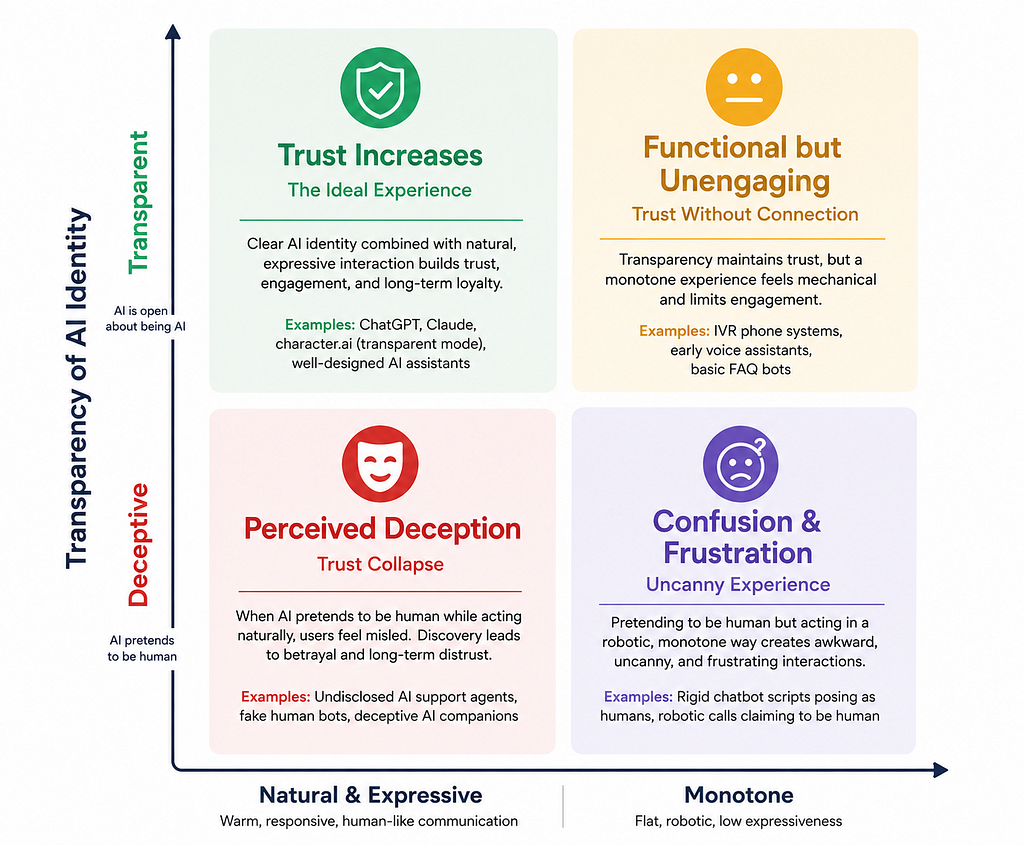
Should you use voice interaction with AI without disclosing that the user interacts with AI?
No.
Even though modern tools like ElevenLabs can create AI voice assistants that are indistinguishable from real speakers, you still shouldn’t create the impression that users interact with real speakers.
Because if users figure out that they interact with AI and not a real human being, they feel tricked. That’s why, when it comes to voice interaction with AI, transparency improves user experience.
Here is a quick summary of how AI transparency and tone of voice impact user comprehension.

Voice is the New UI was originally published in UX Planet on Medium, where people are continuing the conversation by highlighting and responding to this story.