Decades of psychology research, including Harvard’s 85-year happiness study, reveal what genuinely predicts a happy life. Learn what the science actually says about money, relationships, and the habits within your control.
In 1938, Harvard researchers began tracking 724 teenage boys, checking in on their lives every two years, for the rest of their lives. Nobody involved expected the project to still be running 85 years later.

It is. The Harvard Study of Adult Development is now the longest-running study of human life ever conducted, and it has since expanded to include spouses and more than 1,300 descendants of the original participants.
What researchers found wasn’t what they expected going in. It wasn’t career success, fame, or wealth that consistently predicted a happy, healthy life. This article walks through what the actual evidence says, and what it doesn’t.
The single strongest predictor researchers found
After eight decades of data, interviews, health scans, and life histories, one finding has remained more consistent than any other. It surprised even the people running the study.
The quality of a person’s close relationships predicted happiness and health more powerfully than social class, IQ, or genetics. Not the number of friends. Not status. The depth and reliability of a small number of close connections.
Robert Waldinger, the study’s director and a Harvard Medical School psychiatry professor, called this finding genuinely surprising even to researchers who’d expected something else going in. Relationships didn’t just correlate with happiness. They predicted physical health outcomes decades later.
“Taking care of your body is important, but tending to your relationships is a form of self-care too. That, I think, is the revelation.”
Isolation hurts more than researchers expected
The flip side of the relationship finding is just as important, and somewhat sobering. Researchers found that people who were isolated from others were measurably less happy, and the consequences went beyond mood alone.
Isolated participants experienced earlier declines in physical health and brain function in middle age, and on average, lived shorter lives than people who maintained strong social ties. Loneliness behaved like a chronic stressor on the body, not just an emotional state.
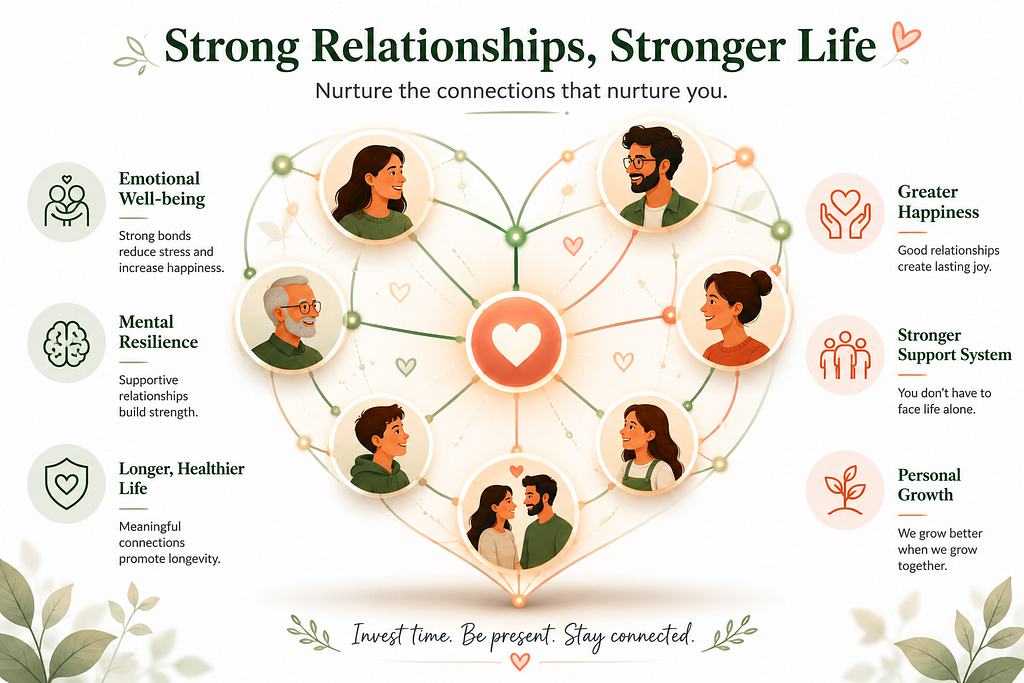
Quality mattered more than quantity throughout the data. Conflict-heavy relationships were sometimes as damaging as having no relationship at all, while even one or two warm, dependable connections acted as a genuine buffer against life’s harder moments.
Does money actually buy happiness? The real answer
This is where popular science writing has genuinely confused people for over a decade, and it’s worth untangling carefully. Two famous studies once seemed to flatly contradict each other.
In 2010, Nobel laureate Daniel Kahneman and economist Angus Deaton found that emotional wellbeing rose with income only up to roughly $75,000 a year, after which more money showed no further benefit. That single number became a cultural fact almost overnight.
In 2021, researcher Matthew Killingsworth published findings that directly challenged this. His data showed wellbeing continuing to rise steadily with income, well beyond that $75,000 threshold, with no plateau in sight.
What happened when they teamed up to resolve it
Rather than arguing past each other, Kahneman and Killingsworth did something rare in science. They collaborated directly, alongside researcher Barbara Mellers, in what’s called an adversarial collaboration, designed specifically to resolve the conflict.
Their joint 2023 finding split the difference, and it’s more interesting than either original study alone. For most people, happiness continued rising with income well beyond $75,000, with no plateau in sight at all.
But for the least happy 20% of people in the sample, wellbeing did plateau, around $100,000 in income, adjusted for inflation. Beyond that point, more money stopped easing whatever was making that group unhappy in the first place.
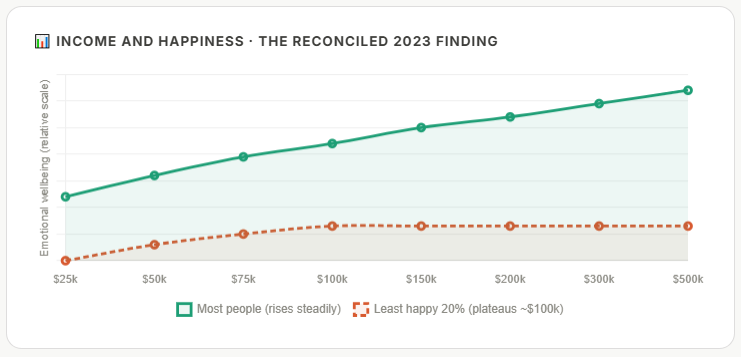
Kahneman and his colleagues put it plainly: that income threshold may represent the point beyond which the miseries that remain, like heartbreak, bereavement, or clinical depression, simply aren’t alleviated by more money. Money helps. It isn’t a cure for everything.
“If you’re rich and miserable, more money won’t help. Money is just one of many determinants of happiness, never the whole equation.”
The 50–10–40 breakdown: how much of happiness you can actually control
One of the most actionable findings in positive psychology research comes from psychologist Sonja Lyubomirsky, and it answers a question almost everyone secretly wants answered: how much of this is even up to me?
Her research suggests roughly 50% of happiness comes from your genetic baseline temperament, the disposition you were simply born with. Another 10% comes from life circumstances like income, health, and marital status combined.
The remaining 40% comes from intentional activities and daily mindset choices, the part actually within your control. That’s a genuinely large slice, and it’s where almost all practical, evidence-based happiness advice tries to intervene.
🧠 What determines your happiness, according to Lyubomirsky’s research
50% Genetic set point: Your baseline temperament from birth
10% Life circumstances: Income, health, marital status
40% Intentional activities: Daily habits, mindset, and choices you control
What the “intentional 40%” actually looks like
Knowing 40% is within your control is only useful if you know what to actually do with it. Across multiple independent bodies of research, a consistent shortlist keeps appearing.

1. Invest deliberately in a small number of close relationships
Given everything above, this is the highest-leverage action available to most people. Reach out to someone you’ve drifted from. Schedule recurring time with people who matter. The research is unusually consistent on this point.
2. Pursue purpose and contribution, not just achievement
The Harvard study specifically highlighted the importance of giving back and contributing to something larger than yourself as a predictor of late-life satisfaction, distinct from career accomplishment alone.
3. Build the six dimensions of psychological wellbeing
Psychologist Carol Ryff’s widely cited framework identifies self-acceptance, positive relationships, autonomy, environmental mastery, purpose in life, and personal growth as the core pillars worth deliberately strengthening, one at a time.
4. Take physical health seriously, especially earlier in life
Participants who maintained a healthy weight, stayed physically active, and avoided smoking and excessive drinking earlier in life consistently showed better physical health and cognitive function decades later in the same study.
What this means for how you actually live
None of this research suggests money, achievement, or ambition are unimportant. They clearly matter, and dismissing them entirely would be its own kind of oversimplification.
What it does suggest is where most people are quietly misallocating their energy. Careers get optimized relentlessly. Relationships, by contrast, often get whatever time happens to be left over after everything else.
The research suggests flipping that default, even slightly, produces an outsized return. Not because relationships are sentimental, but because eight decades of rigorous data keep landing on the same conclusion independently.
“Social fitness deserves the same deliberate attention we give to physical fitness. It doesn’t maintain itself just because we wish it would.”
The bottom line
Roughly 40% of your happiness sits within reach of daily, intentional choices. Relationships consistently outperform almost every other variable researchers have tested. Money helps, especially when you don’t have enough, but it isn’t the ceiling people assume.

What Actually Makes People Happy? The Real Research, Explained Simply was originally published in UX Planet on Medium, where people are continuing the conversation by highlighting and responding to this story.