and why infrastructure matters more than ever
Since the very beginning of the internet era, hiring was constrained by two things: human bandwidth and geography.
A recruiter could only review so many candidates, a hiring manager could only conduct so many interviews.
And when the perfect candidate lived halfway around the world, employing that person could require understanding region-specific labor laws, establishing payroll, managing taxes, and figuring out whether the person should legally be an employee or a contractor.
AI is removing the first constraint remarkably quickly.
But the second one is proving much harder.
In 2026, AI can already help companies define roles, write job descriptions, discover candidates, analyze applications, run preliminary assessments, coordinate interviews, summarize conversations, benchmark compensation, and support hiring decisions.
But employing a new team member correctly can still be tricky.
In this article, I want to review the current state of the hiring process, the role of AI in it, and the rise of HRIS platforms like Deel that handle compliance, employment, and payroll infrastructure underneath an increasingly AI-driven hiring workflow.
The traditional hiring funnel is turning into an AI loop
Think about a conventional hiring process.
A manager realizes they need another designer or engineer. HR creates a requisition and helps write a job description. Recruiters search LinkedIn or an internal database. Hundreds of applications arrive. Recruiters manually narrow them down. Hiring managers interview a shortlist. Job details are negotiated and department prepares an offer.
Then onboarding begins.
This process is fundamentally sequential:
Define role → source → screen → interview → offer → hire → onboard → payroll
AI started to change this status quo; and many of these activities can happen simultaneously, continuously, and with far less human effort.
An AI recruiting system can inspect the skills already present inside an organization, identify a capability gap, help formulate a role, generate sourcing criteria, search candidate pools, compare profiles, summarize applications, and prepare structured interview questions.
Hiring starts looking less like a funnel and more like an agentic loop:
Identify need → search → evaluate → learn → refine criteria → search again → escalate the best candidates to humans
Its possible to identify 5 major changes that happens in hiring space in 2026 all due to AI usage:
1. AI is changing how companies define who they need
The transformation actually begins before a job is advertised.
Traditional workforce planning relies heavily on job titles.
- We need a backend engineer.
- We need a marketing manager.
- We need a customer-support specialist.
But AI is making skills much easier to analyze independently of titles.
A system can look at the capabilities already available across a team, compare them with upcoming projects, and identify a missing combination of skills.
Instead of asking: “Do we need another product manager?”
a company can increasingly ask: “What capabilities are missing if we want to launch this product in Latin America?”
And the answer might not map neatly to a traditional job title.
2. Talent sourcing becomes global by default
Once a company knows what capabilities it needs, AI changes another assumption: where the candidate should live.
Imagine that a London company needs an AI engineer with experience in healthcare, Python, medical-device regulation, and training large language models.
A conventional recruiting process might begin with:
“Find candidates in London.”
An AI-native process can begin with:
“Find the strongest people who meet these criteria.”
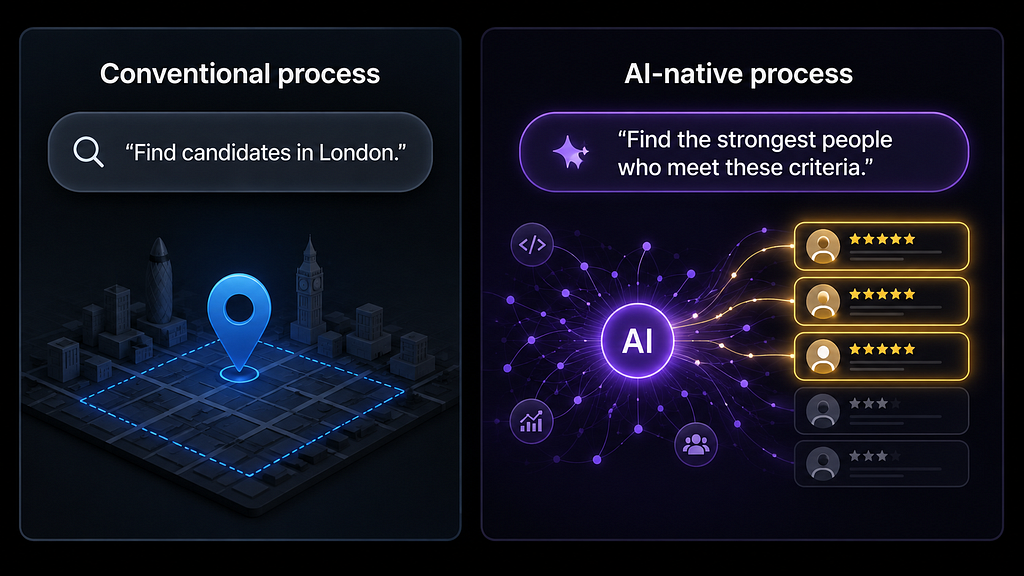
Location can become a secondary constraint.
Global hiring was historically something companies consciously decided to do. But in an AI-native hiring environment, it can become the natural consequence of searching by skills.
3. AI dramatically compresses screening
Candidate volume has always created an information problem.
A recruiter might receive 600 applications for one position but realistically inspect only a fraction of them deeply.
AI changes the economics of that process.
A system can analyze hundreds or thousands of candidate profiles against structured requirements and identify signals such as relevant experience, transferable skills, domain expertise, portfolio evidence, or missing qualifications.
That allows recruiters to spend their time on ambiguous and high-value decisions rather than repetitive document processing.
4. HRIS streamline hiring process
The critical moment comes after AI finds the perfect candidate
Suppose the system works exactly as intended.
- A company discovers an exceptional specialist in a certain location.
- The candidate passes the assessments.
- The hiring manager wants them.
- Compensation is agreed.
From the perspective of the AI recruiting workflow, the job is almost finished. But from the perspective of the company, however, some of the hardest questions have only just appeared.
- Should this person be an employee or an independent contractor?
- Does the company have a legal entity in the region where this person is based?
- What contract is required?
- Which statutory benefits apply?
- What taxes need to be withheld?
- How should payroll work?
These questions cannot be solved simply by asking AI.
They depend on jurisdiction, employment status, company structure, local regulation, payroll rules, and continuously changing legislation.
And this is the point where global hiring stops being a recruiting workflow and becomes an infrastructure workflow.
Platforms like Deel become the execution layer underneath the AI hiring stack.
And one useful way to understand how exactly they support hiring is to break AI-powered hiring process into layers
- Layer 1 (Intelligence): AI models and agents help companies understand what talent they need.
- Layer 2 (Talent discovery): Recruiting platforms identify candidates across increasingly global talent pools.
- Layer 3 (Evaluation): AI supports screening, assessments, interviews, ranking, and decision preparation.
- Layer 4 (Employment infrastructure): Turning the selected candidate into a legally valid worker. That means handling contracts, classification, employment entities, payroll, taxes, benefits, compliance, and payments.
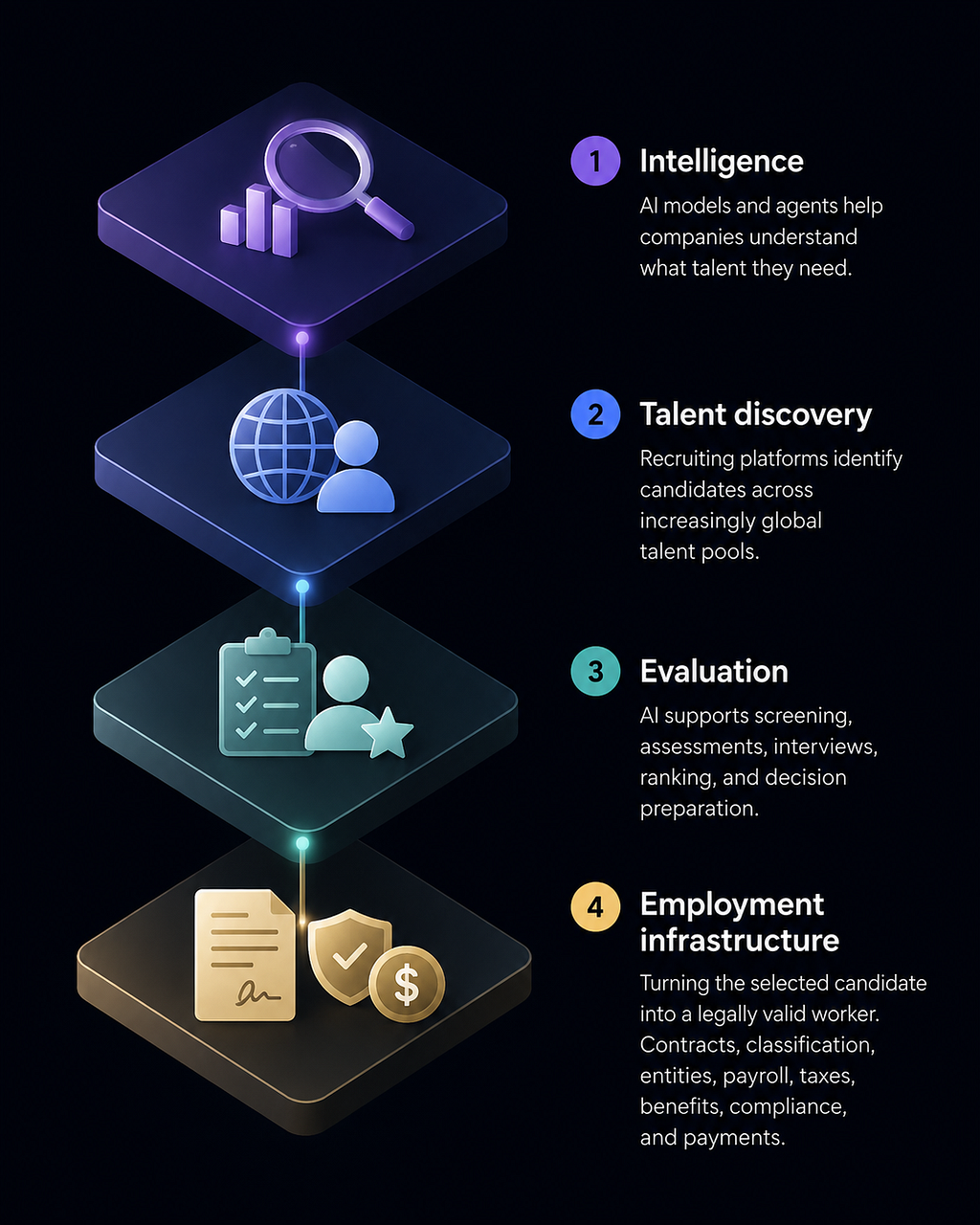
Layer 4 is the layer where Deel shines.
Deel’s platform supports companies hiring & managing workers across 150+ countries and provides multiple employment models, including direct employees, Employer of Record arrangements, PEO workers, and contractors.
If a company wants to hire someone as an employee in a country where it does not maintain its own legal entity, an Employer of Record can become the legal employer while the company continues directing the employee’s day-to-day work. The EOR manages functions such as local employment contracts, payroll, statutory contributions, and employment compliance.
5. Payroll becomes part of the AI system
Smart payroll management becomes one of the most important parts of AI-powered hiring.
Payroll contains an unusually dense collection of structured information about the real relationship between a company and its workforce. And that makes payroll infrastructure extremely valuable for AI.
Deel’s 2026 product direction reflects this idea. Its AI Workforce includes purpose-built agents across areas such as payroll, HR, PTO, IT, and compliance. Deel says its payroll AI can flag anomalies before payroll is run, trace changes to their source, and surface missing information for review. Human teams retain control over decisions and approvals.
This is an important distinction between two generations of enterprise AI.
The first generation (like daily AI tools we use to build things) sits on top of software:
Ask a question → receive an answer.
The emerging generation sits inside the workflow:
Detect an issue → understand context → recommend or execute an action → request approval when required → record what happened.
For payroll, that might mean detecting an unexpected salary change before thousands of payments are processed rather than discovering the error afterward. Deel describes this as moving error detection upstream, using structured workforce data and country-specific rules as context for the AI.
The future global hiring workflow looks very different
Put all these changes together and the global hiring workflow of 2026 starts to look like multi-step process:
- A manager describes a business outcome.
- AI identifies the skills required.
- The system searches internal and external talent pools globally.
- AI surfaces qualified candidates regardless of location.
- Candidates complete structured assessments.
- AI organizes the evidence and flags areas requiring human judgment.
- Recruiters and hiring managers conduct the critical interviews.
- A human selects the candidate.
- Then the infrastructure layer takes over.
- The system determines possible employment models.
- Classification and compliance risks are evaluated.
- The appropriate local contract is generated.
- An EOR can employ the worker when the company lacks a local entity.
- Required documents are collected.
- Benefits and equipment are provisioned.
- The worker enters the HR system.
- Payroll is configured according to local rules.
- AI monitors the resulting workflows for anomalies and missing information.
As you can see, the process does not end when someone signs an offer.
Hiring becomes the entry point into a continuous workforce-management system.
Written by Nick Babich

How AI Is Transforming Global Hiring in 2026 was originally published in UX Planet on Medium, where people are continuing the conversation by highlighting and responding to this story.